Inaugural Meeting

WORKSHOP
Against the backdrop of deepening ecological, political, and economic crises, our first gathering brought together leading scholars, journalists, and activists to rethink the role of finance in shaping our collective futures. Rather than treating collapse as a moment of failure, the workshop explored it as a space of possibility, where new alliances, practices, and ways of valuing can emerge. Through conversations spanning climate, democracy, digital infrastructures, and grassroots innovation, we asked: What comes after collapse? And what kind of financial imagination do we need to build it?
Curatorial Note
Till Wittwer
There is something perpetually elusive and unstable about finance, a practice that— despite insistent contrary claims—is fundamentally “unreasonable,” meaning: cannot be grasped with reason alone. This begs the question: How do we grapple with finance, then, this slippery, evasive practice? How can we depict something that casts no shadow, and how do the forms we find to achieve this matter in shaping what finance is?
A collapsing building (the Trump Plaza hotel and casino in Atlantic City, demolished in 2021) serves as the visual “Leitmotif” of the Collapse Finance workshop. Its various stages of disintegration (alongside the according timecodes) appear in cardboard cutouts and props as pieces of set design, in a printed handbook and video projections.


However, it is neither the literal idea of “collapse,” nor the rather shallow symbolism (an imploding casino! Built in a failed city! By Donald Trump!) that becomes the center of the aesthetic and curatorial framing, here. Quite to the contrary: The task is to look past these readily available, flat surfaces and images—which, coming as slightly farcical, down-scaled stage props, are being exposed as such—and rather focus on the process of collapse itself:
A sturdy, static edifice, embedded in a broader socio-political context, is being transformed into a dynamic and impossible- to-grasp, ever shape-shifting plume of dust and debris that expands across space and time as something that is both visceral, material, transgressive, as well as etheric, fleeting, highly unstable.
The kinetic energy stored in the rigid structure is released at once and unravels in an awe-inspiring, all-enveloping, opaque plume of dust. It is this very moment of collapse when the ungraspable, elusive, unreasonable quality of finance can be intuited as it assumes a volatile aesthetic non-form.
In the Collapse Finance workshop this central visual motif of dynamic instability is echoed by a gathering space organised to resemble an informal discussion group more than an academic conference. Brief inputs (“provocations”) by the participants structure the individual sessions held throughout the two workshop days,
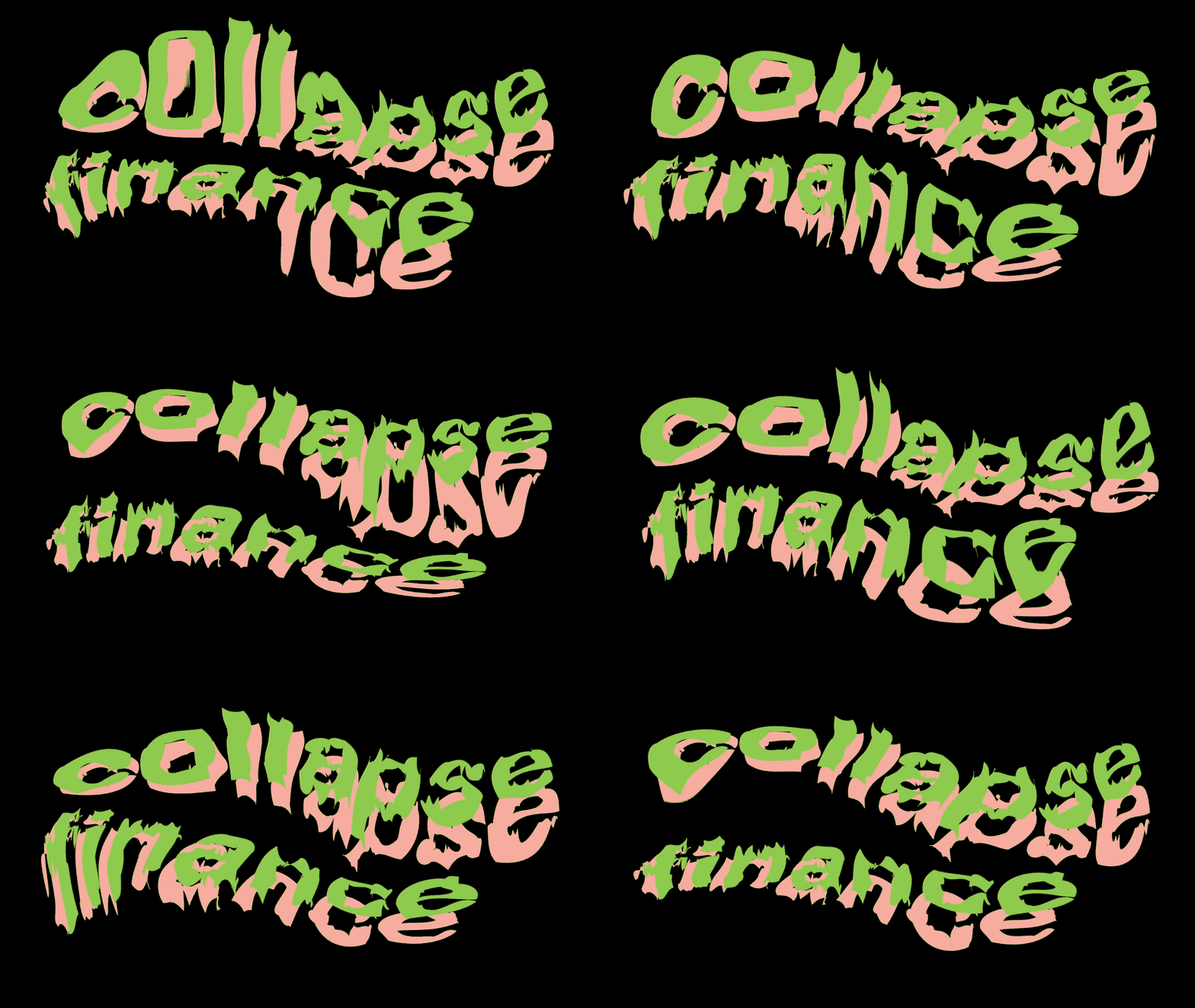
a custom “liquid” typeface that begins to break down semantic legibility, paired with the sturdy reliability of a bold Helvetica font frames all public communication, such as a handbook that can be read from front to back and back to front (“Collapse Finance” here flips into “Finance Collapse”), just to inevitably loop back towards the center fold image: All-consuming dust plumes rising as the building disintegrates.


A playful dinner menu concluding the first workshop day reflects sensory uncertainty and language as a destabilising agent amongst the ruins of consumable commodities, a color scheme of toxic green and fleshy peach suggests something tipping towards the artificial, constructed.

How do the forms we find matter in shaping what finance is?
MEDIA
-
The Future of Collective Finance
Melinda Cooper | Interview
Melinda Cooper, one of today’s most influential political theorists based at the Australian National University, explores what forms of collective finance could emerge if we move beyond the limits of Keynesianism and orthodox ideas of the welfare state. Watch now
-
Reshaping Money
Gillian Tett | Video
Gillian Tett, the renowned Financial Times journalist and Provost of King’s College Cambridge, offers a piercing perspective on the current geoeconomic crisis and the role of global finance within it. She examines three pivotal dynamics of our moment – deregulation, de-dollarisation, and digitalisation – and shows how these forces are reconfiguring the meaning and function of money today. Watch now
-
The Possibility of Democratic Finance
Natasha van der Zwan | Interview
Natasha van der Zwan, a leading public governance expert at the University of Groningen, examines the deep ways in which finance shapes everyday life and sets out a vision of finance organised for public good. Watch now


